De Twips
Wildeburg festival
Ambition
In the spring of 2025 a small team set out to build the most ambitious tensegrity I had ever attempted: a ten-meter-tall humanoid figure, mounted on a pair of shipping containers, to dance over the festival grounds at four festivals in The Netherlands.
We called him De Twips.
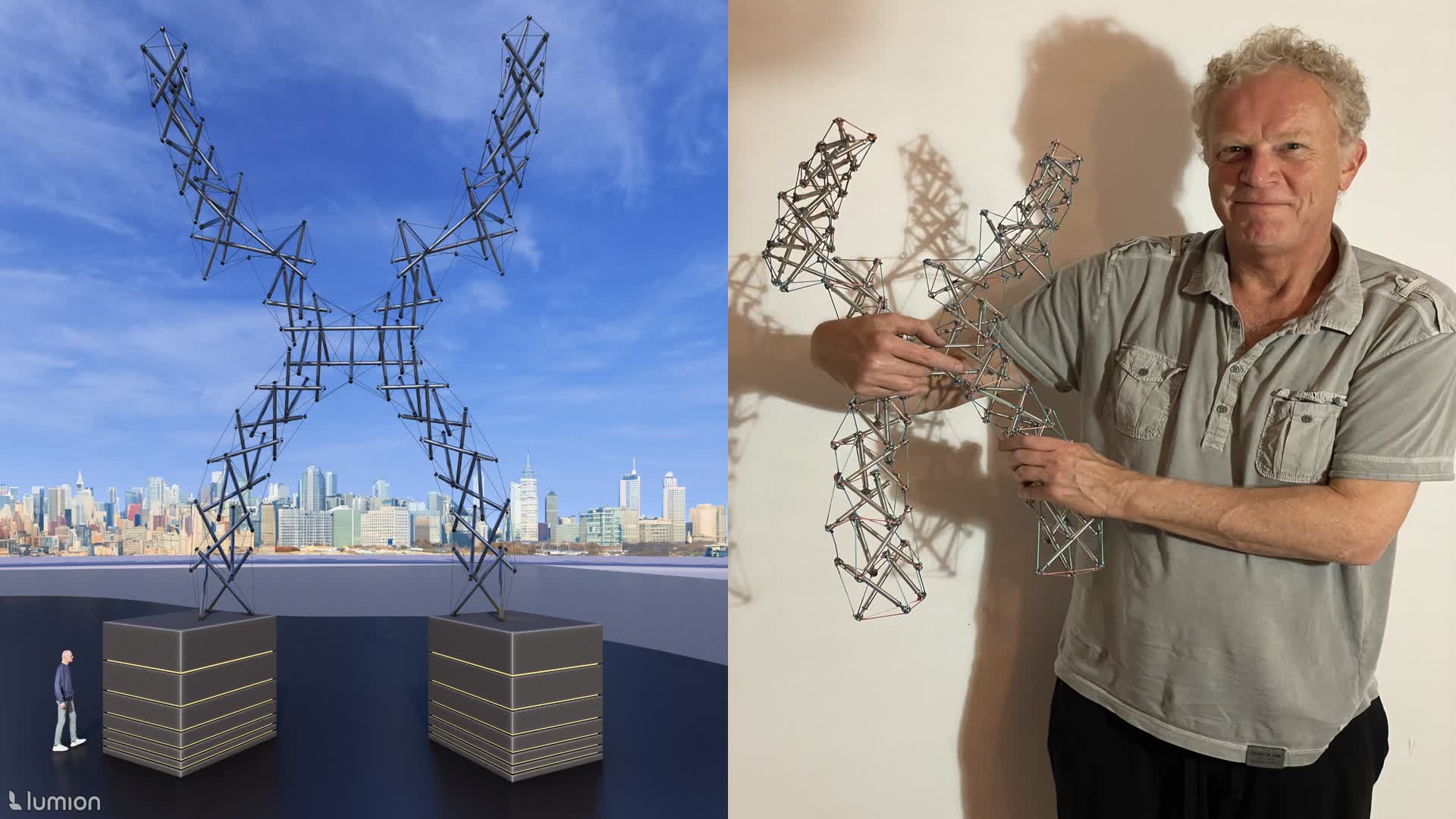
The idea was simple to describe and tricky to engineer. A figure with articulated limbs, made entirely of push-and-pull — aluminum struts held in space by a web of cable — that would read, from a distance, as a person caught mid-motion. The “Booty Shake Tensegrity”, as we sometimes called him in the chat group.
I had the artist’s hand on this one and Ate Snijder had the engineer’s. We started detailing the design in March, refined connections through April, and began fabrication in May.
Prototype
A humanoid form means complex force paths and it would require guy limes. Limbs raised high introduce significant forces. It had to be able to withstand fairly high winds. None of these are insurmountable, but the only way to know how they actually behave is to build something and watch.
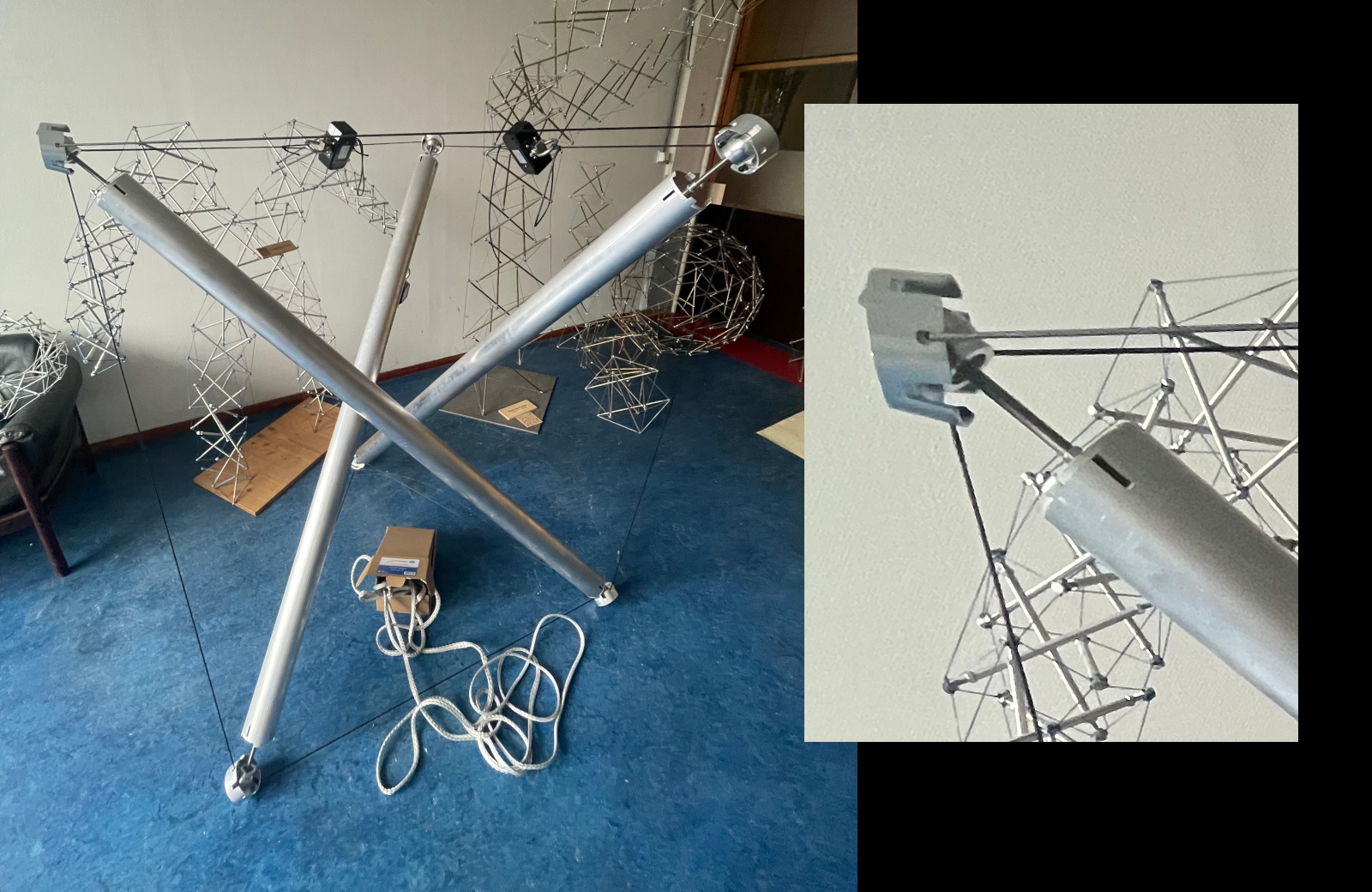
The small prototype told us, almost immediately, that the design was harder than the drawings made it look. The big challenge is the design of the part where the tension meets the compression, and our first attempt was not satisfying. We pressed on anyway, switching to a new design and skipping over the prototype phase this time because there wasn’t time. This was not exactly wise.
Aluminum and Dyneema
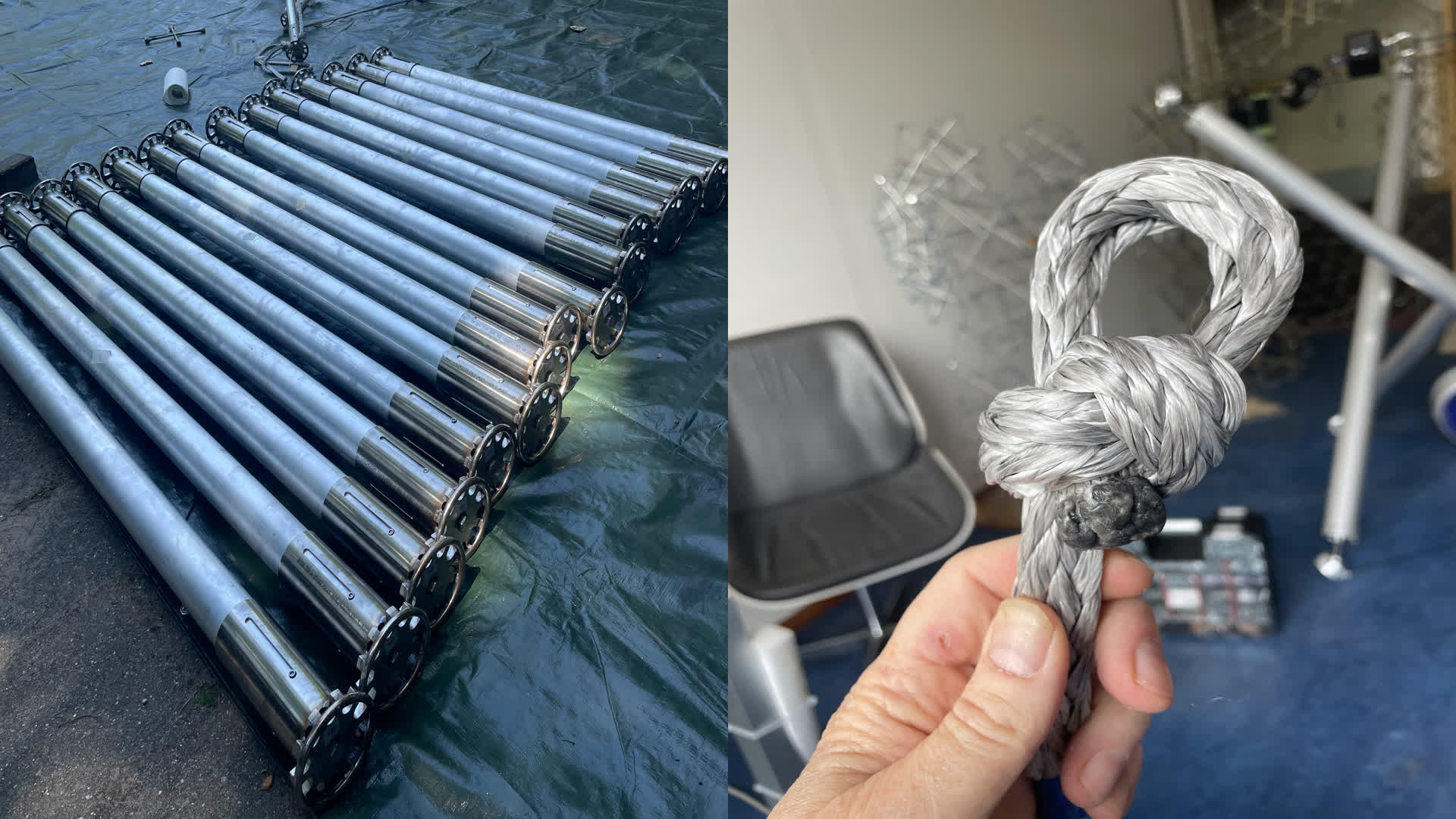
The struts were aluminum tubes with threaded rod ends — the same family of adjustable struts I’d been using for years, just longer and thicker. The cable was Dyneema, beautiful stuff, almost inelastic. The idea was that with a screw action we could lengthen the struts.
It was quite charming that the technique of using Dyneema and knots was something that could be done at this large scale almost exactly as I had built things at the smaller scale.
In theory.
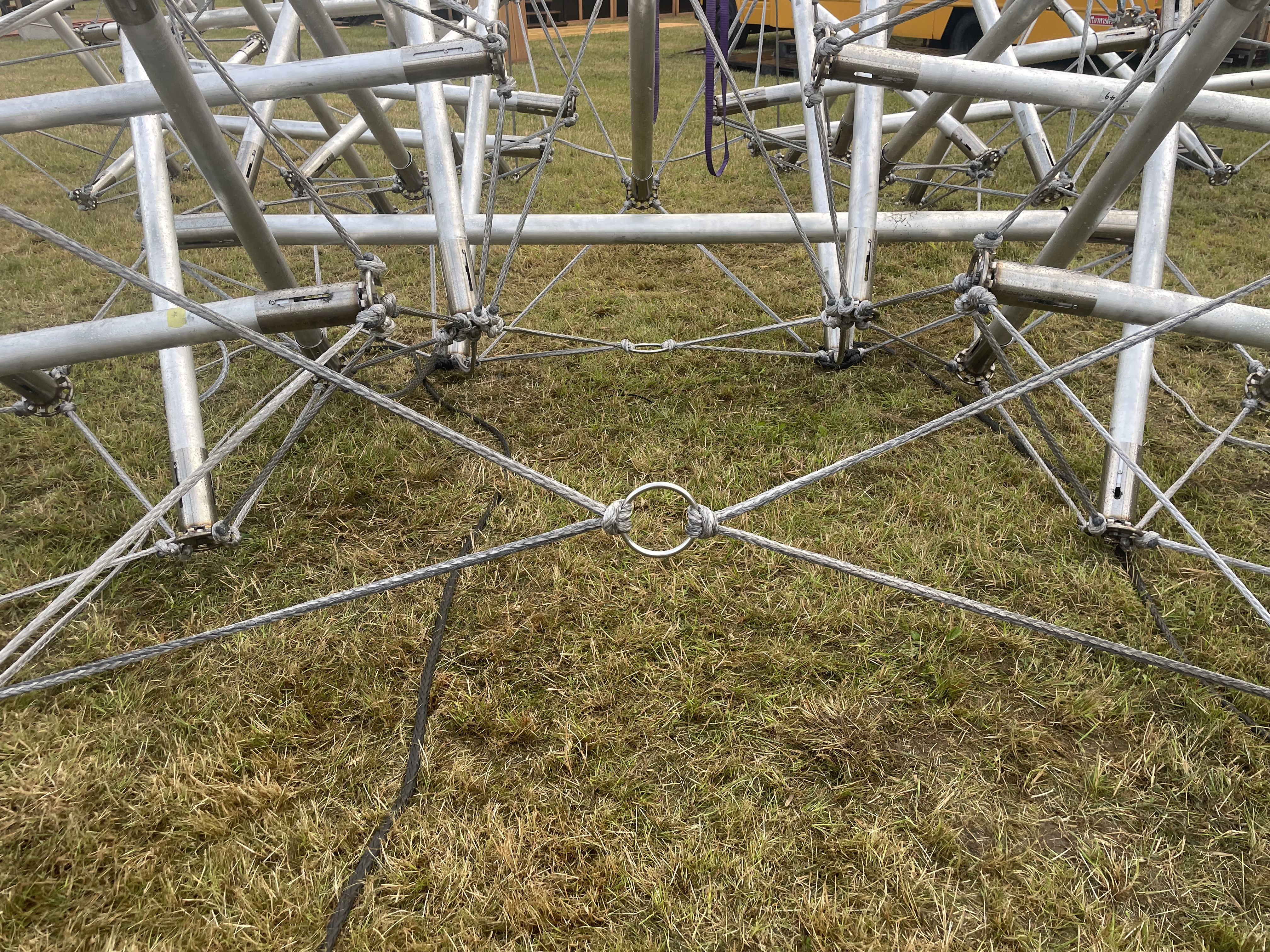
In practice, the plastic creep of a freshly tensioned Dyneema cable is something you have to feel in your hands. We pre-tensioned, the rope stretched. We tightened, the rope stretched. Actually, it was the knots that were the cluprits. We couldn’t tie them tight enough by hand that they would not pull a great deal tighter when under serious tension. A cable could give back 110 mm of slack just from being asked to hold tension for the first time. Multiply that by the multitude of cables and a humanoid form with no spare degrees of freedom, and you have a structure that never quite arrives at “tight”.
Building
By June the parts started arriving in Rotterdam and the welding job was started for the huge number of strut caps. The first parts which arrived were for the arms so we got started, even though the rest was not yet available. Here was where we encountered the deadly problem which was to plague the whole construction process.
Both the bolt and the nut at the end of each strut was to be the means by which we bring about a significant amount of pre-tension in the structure. We would turn the bolt counterclockwise and this would lengthen the strut. Unfortunately the materials for both of these was stainless steel, and we discovered that stainless steel bolts and nuts are problematic. Something about the material’s characteristics made the bolts sieze up!! We were unable to turn the bolts inside the welded nuts, since they were anywhere from very hard to turn all the way to actually frozen solid.
This was a huge problem, and it affected everything about the structure. We could not properly lengthen the struts to bring about tension.
Eventually we discovered that we could get a kind of paste (very expensive!) which contained something like copper nanoparticles, and with this added, the bolts were able to turn again, but not really easilly. We also had to apply the paste retroactively to everything which was a chore.
Eventually we were able to construct the arms and the legs, with the torso section attached to the legs. We lifted the lower section up with a crane to see how it looked, and it was very impressive, however it really didn’t look tight enough.
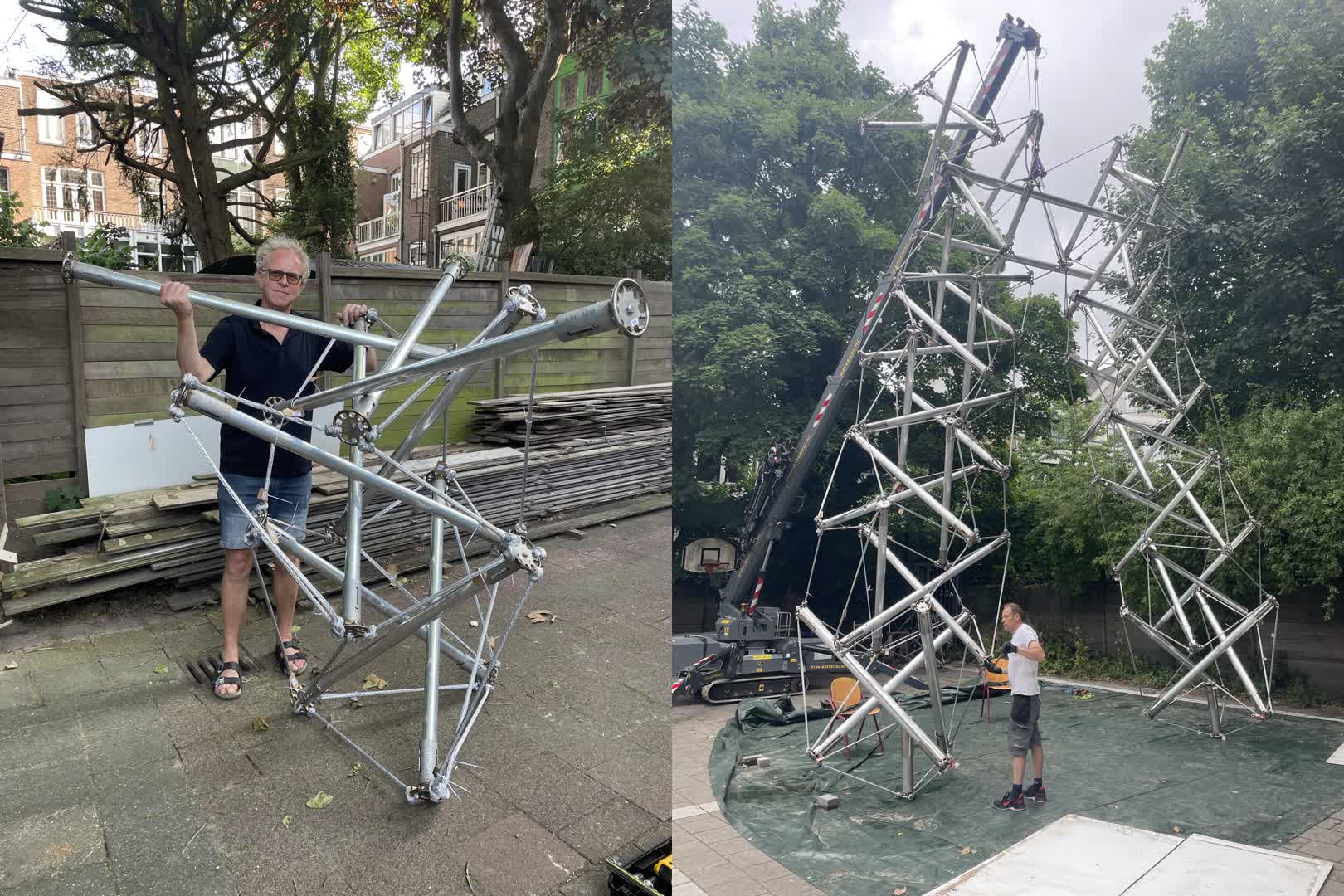
We had the arms/shoulders and the legs/torso assembled and the clock was ticking, so we had to figure out how to get the object transported to the festival site. Originally the idea was that we could simply screw all the bolts out, stack the bars, fold up the network of cables and caps, and it would be compact.
However, now that the bolts were being extremely difficult, we could not remove the bars, so we had to choose particular cables to sever and we were able to break it into parts which could potentially fit on a truck. This was very difficult, to say the least.
Every day was a roller coaster of emotions, going back and forth between hopelessness and new glimmers of hope. It also happened to be a heat wave so we were sweating in 32C temperatures.
On the truck
Late June: containers were placed at Netl, the severed parts were guided through an opening that was just large enough for them to pass, and amazingly we loaded them onto the truck in Rotterdam. We were exhausted but there was hope again, and De Twips left Rotterdam for the site on the Noordoostpolder. It was a herculean effort for everyone involved to get these parts on the truck and tie them down so that it could all be safely moved on the highways. Later we found out that he had been stopped by police on the highway to check his load.
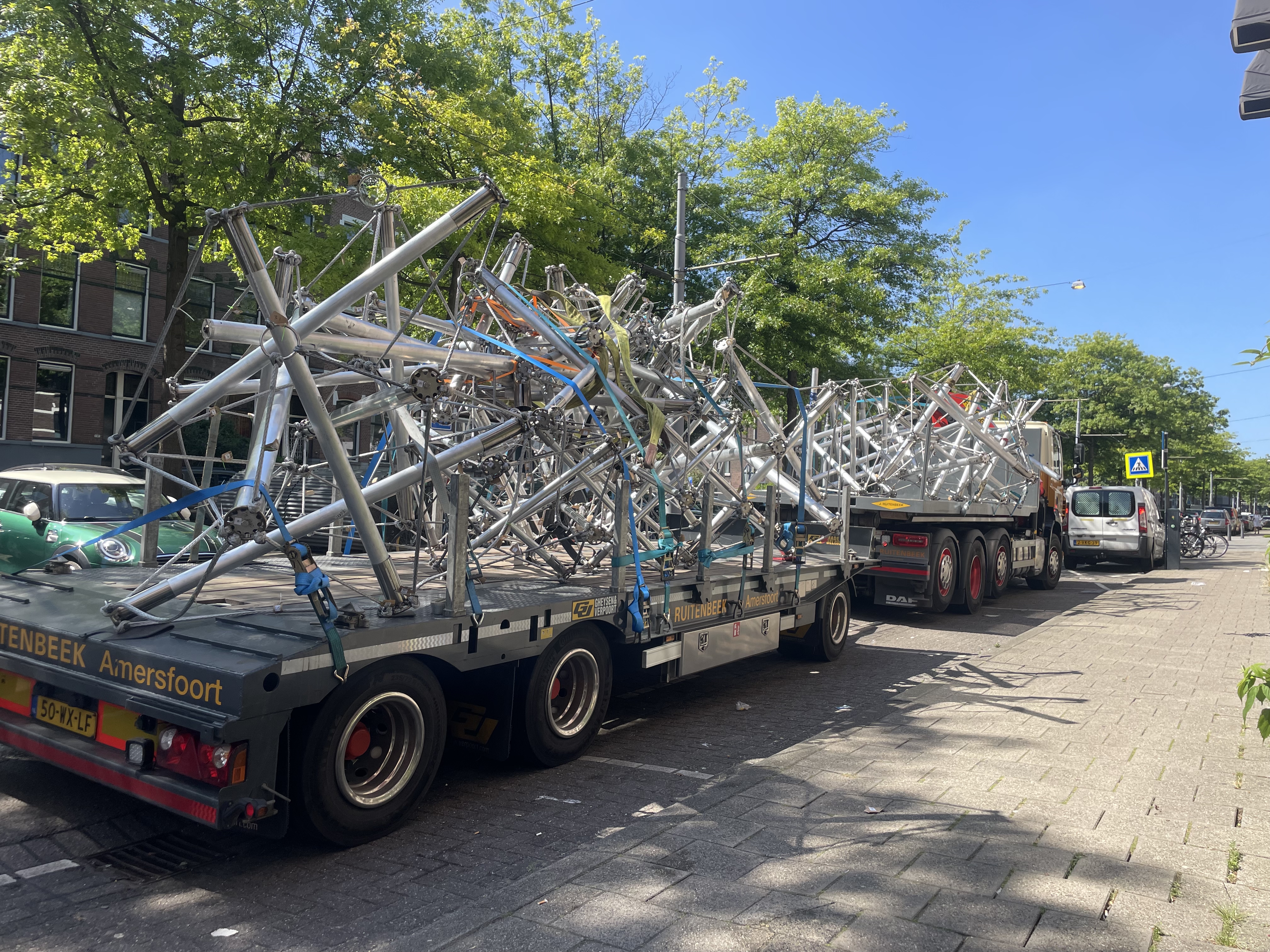
Arrived onsite
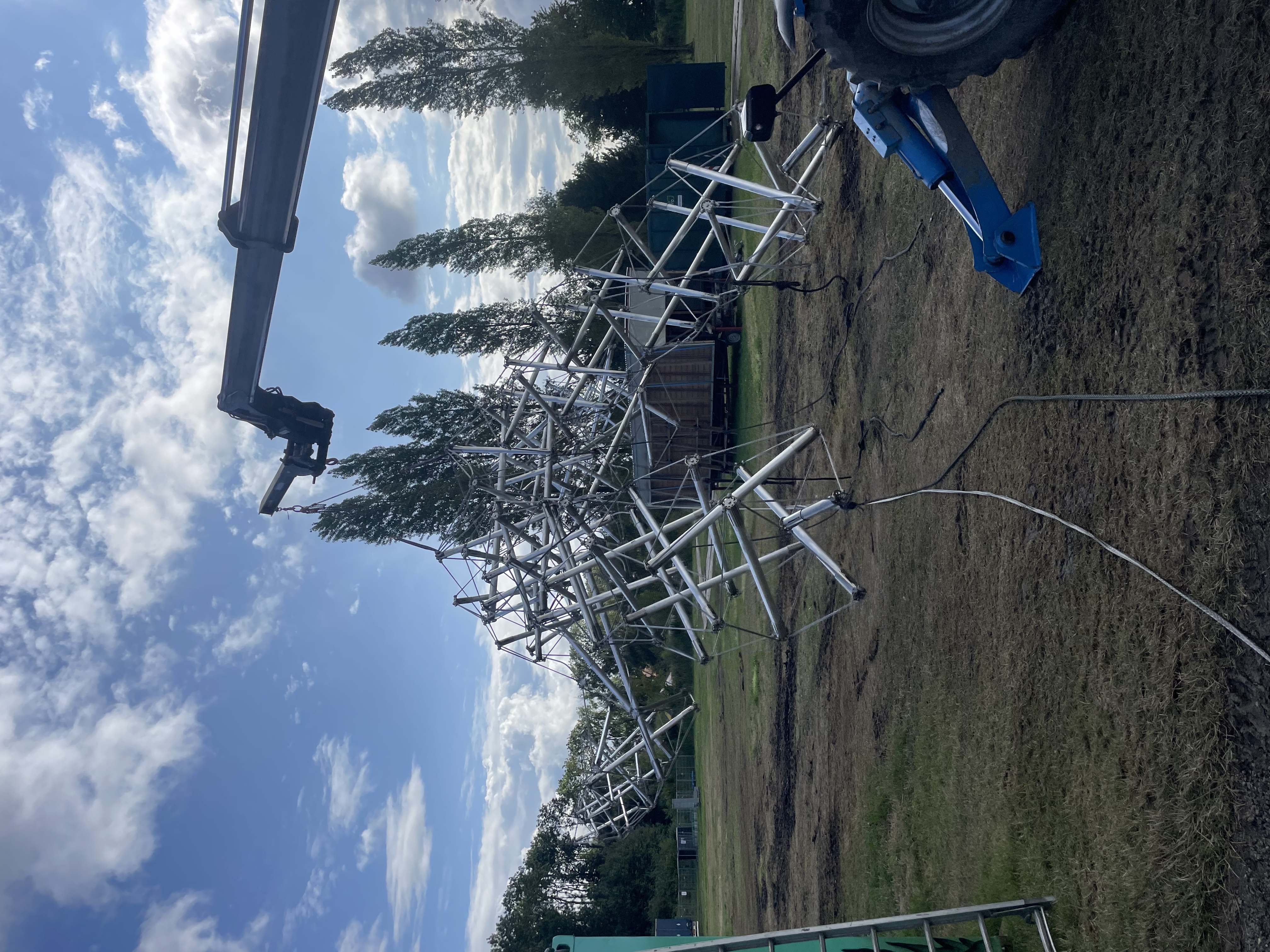
At Netl de Wildste Tuin we found the the parts laid out on the grass. The picture below is of the pelvis which looked impossible to reconstruct at first. The individual leg portions and the shoulders/arms were laying separately. We had a lot of work to do still, reconnecting the cords that we had had to sever, and the whole time battling with the seized up or partially seized up stainless steel bolt mechanism in the struts.
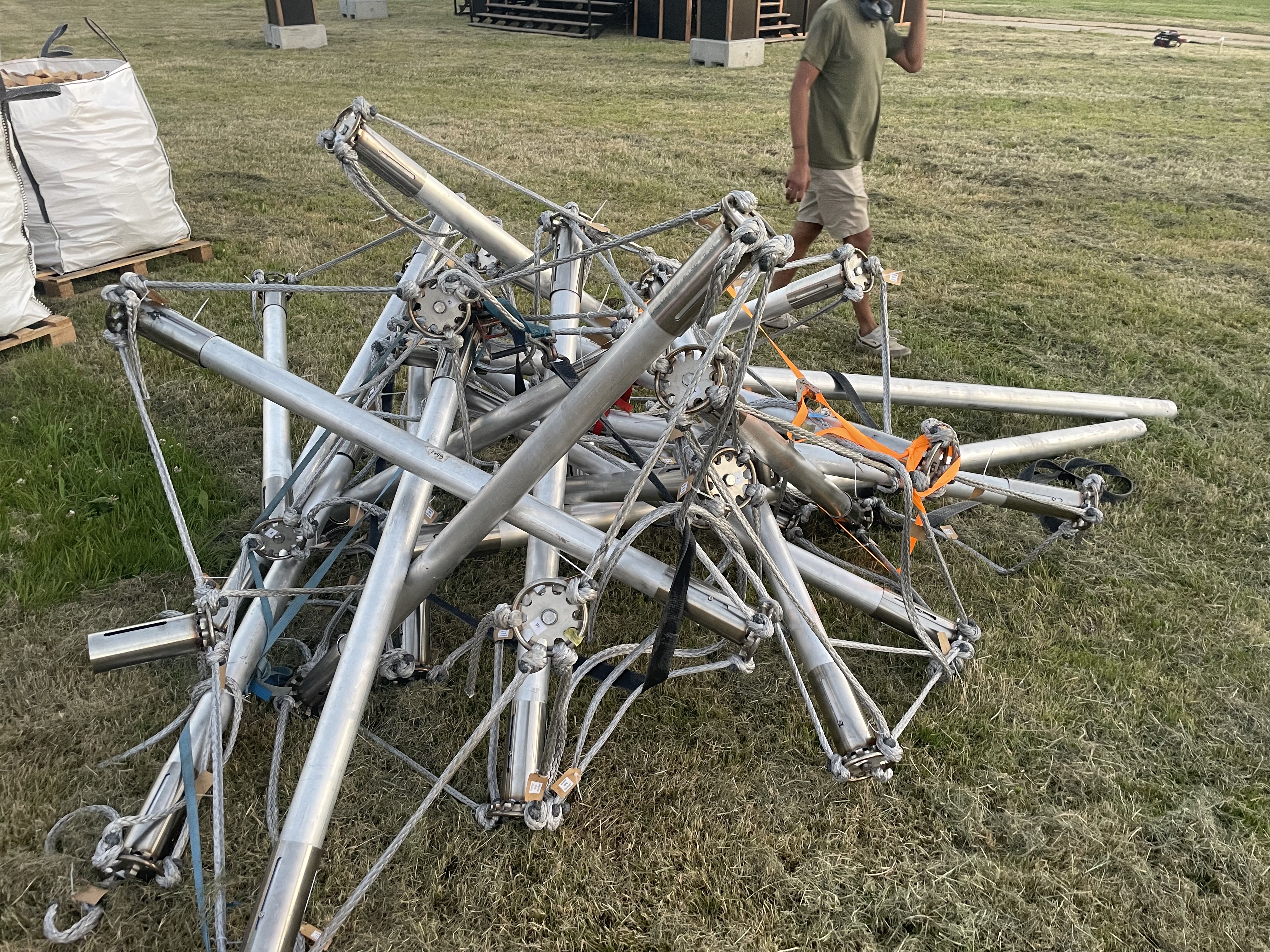
Erection day
It was again hot, around 33C, but we got busy connecting the parts together after having untangled the pelvis section. It was amazing but we were able to connect the whole structure together and with a whole lot of strong-arm effort we were able to lengthen the struts to create some pre-tension. There was De Twips, laying on the grass.
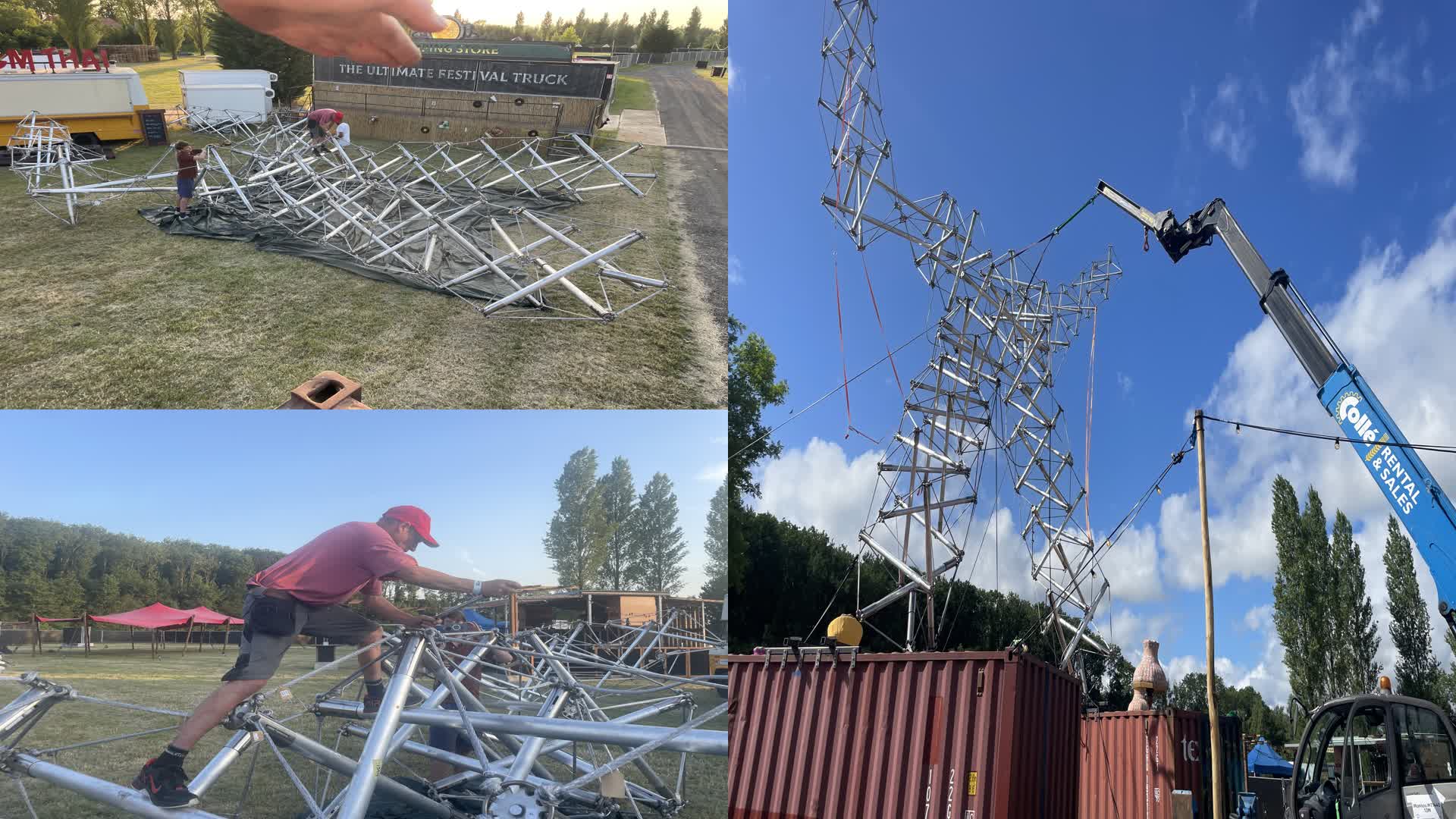
We requested the big telescopic lifter vehicle and we were able to lift the entire structure up on top of the containers and connect it in place. The structure weighed about 800kg so it was no small feat.
Another difficult aspect was the guy lines that were necessary to hold him upright, since the connections at the ends of the legs were able to pivot. Getting the tension on the guy lines was very tricky indeed and it took a long time, while the lift vehicle had to remain in place to hold it up.
The visual impression it gave when you were near it was quite breathtaking! The scale of it was really enough to make you stare.
We have a problem
Then the crucial moment came when we had the guy lines in place and he was standing upright, because of course he had to be released from the crane and stand on his own. It almost looked good for a moment, and the emotional roller coaster hit a brief high point, however upon further inspection we could see that the pre-tension was nowhere near enough. One of his legs was bent, simply too weak, and this was a portion of the structure where the struts were completely seized up and we couldn’t lengthen them at all anymore.
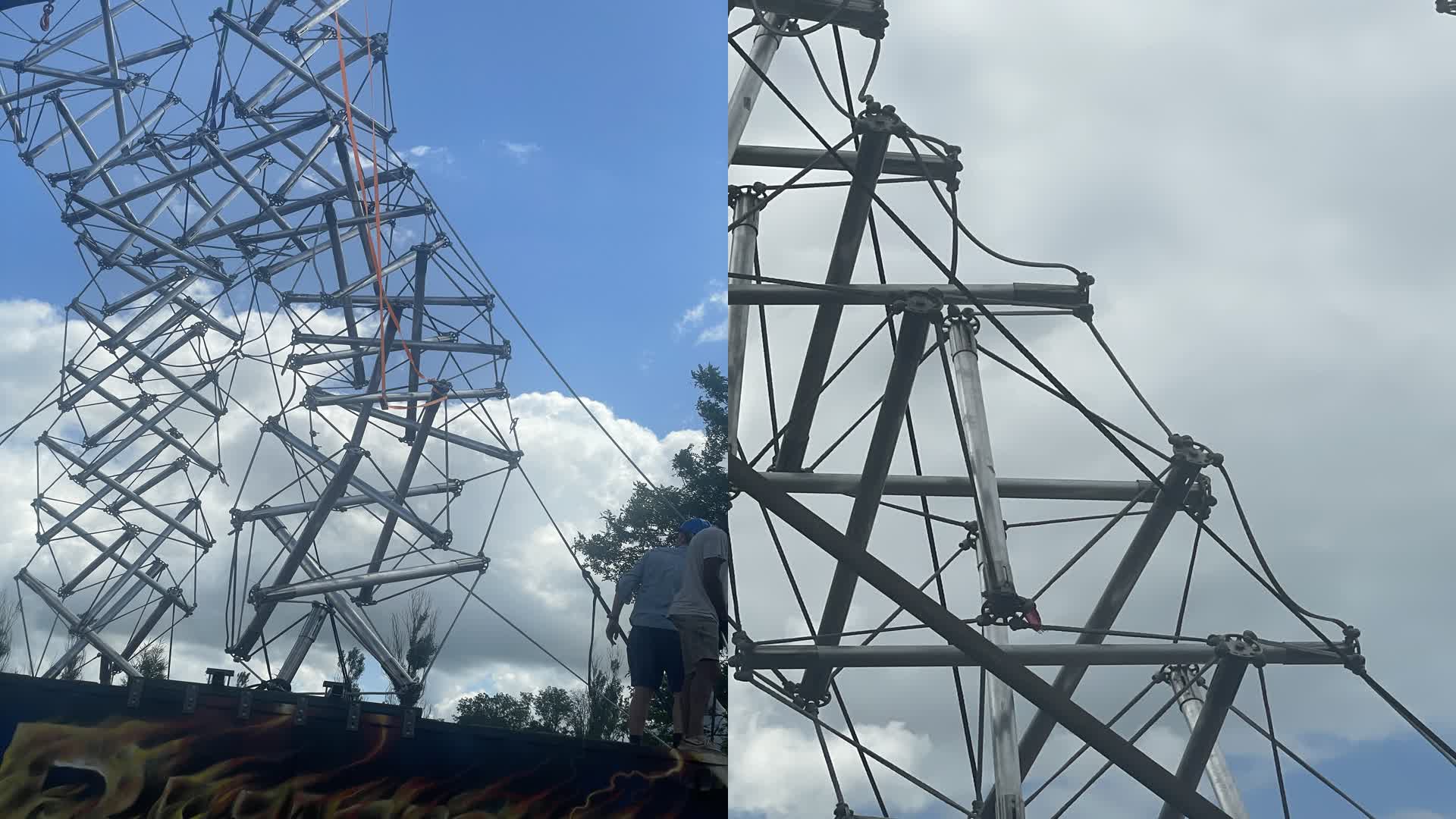
Maybe people who don’t understand tensegrity could look at it and not see a big problem, but my heart sank when I saw loose cables and there were also bars which were nearly touching each other. I became quite despondent.
Second attempt
There was no choice, we had to take him down and lay him in the grass again while we figured out what to do next, or if indeed anything could be done. The time remaining until the first festival was too short, so we had to give up for now and lay De Twips in a field which was hidden from the festival attendees. We had missed the first festival, which was very painful.
Stabilization
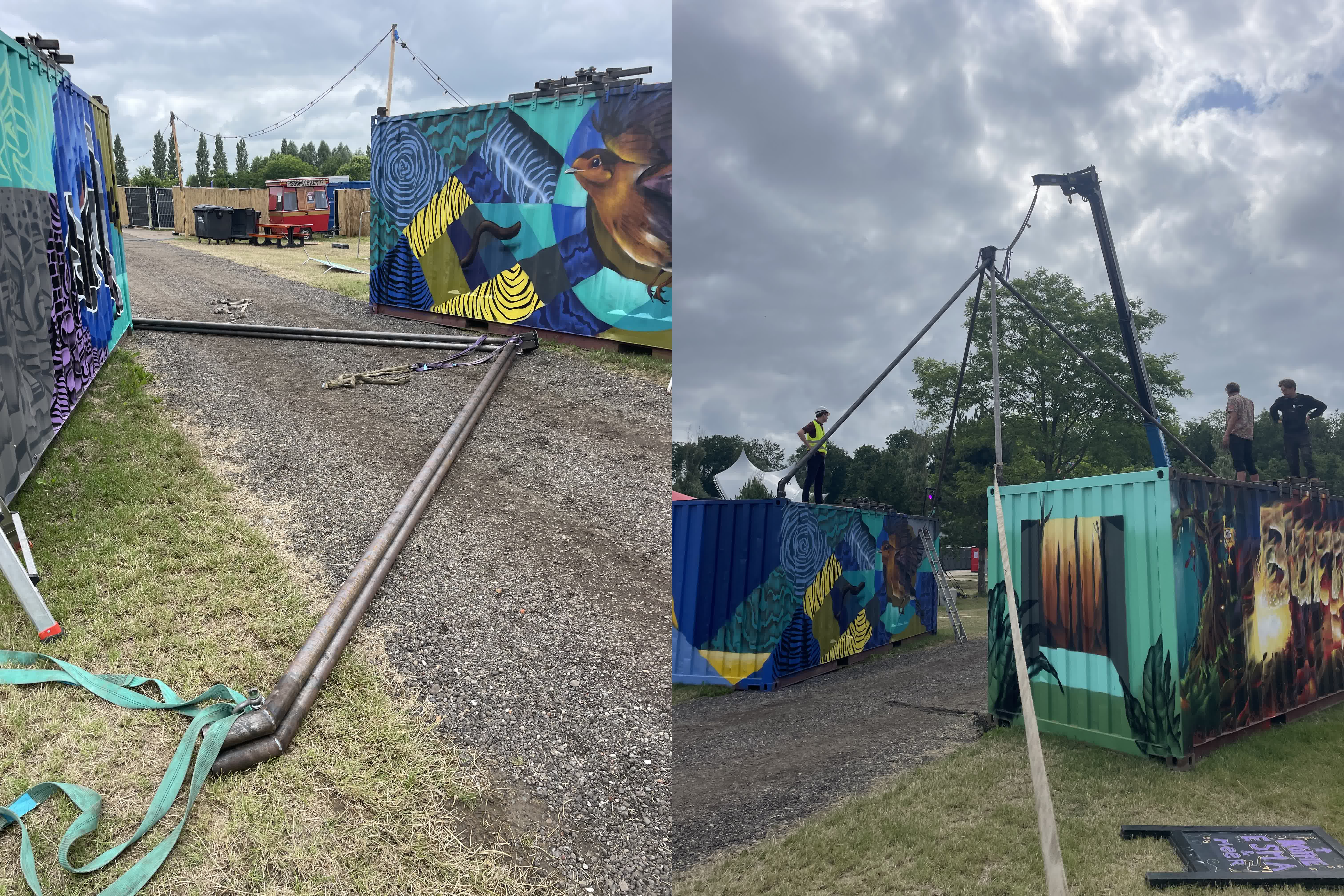
Between the first festival and the second we had another chance to erect De Twips, but it was clear that he could not stand on his own. We got help from a very clever and capable builder Jeroen who constructed a kind of emergency “saddle” for him to lean on.
Beyond that, we also put in a valiant effort to add tension cables in various places to stablilize the structure. None of this was very pleasing, but we really had no choice.
The saddle
A new saddle bridged the steel pyramid to the figure’s pelvis. It was mounted on the containers and, quite remarkably, it was all well enough designed and built that it was sufficiently solid.
On the saddle
Once again we got the telescoping crane and lifted De Twips up, but this time the challenge was to connect the apex of the new steel pyramid to the pelvis section.
I was almost in disbelief but it actually stood and it was solid enough to be deemed safe for the second festival.
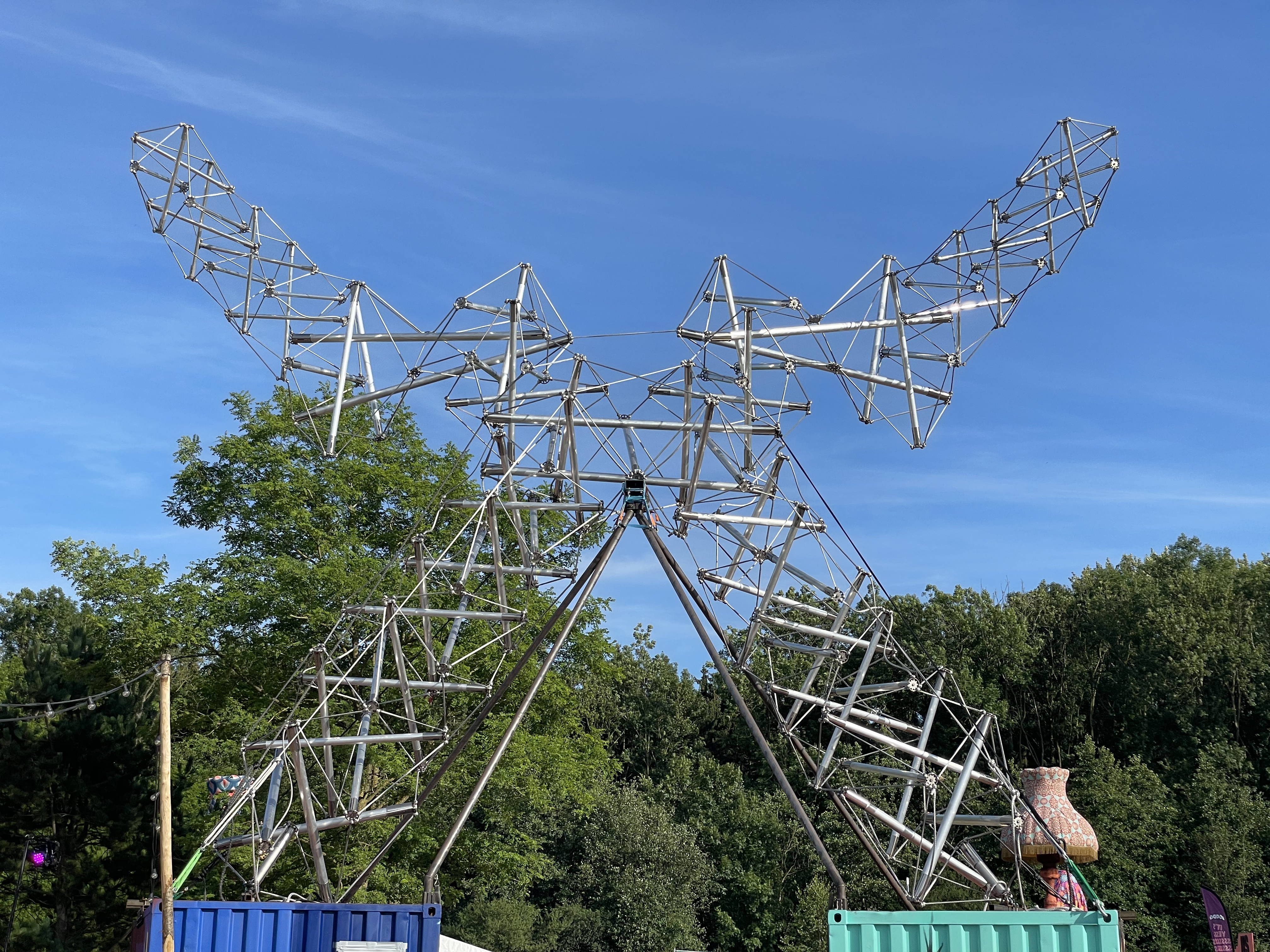
On the one hand I was relieved and happy that it stood, but on the other hand this didn’t feel like a great achievement because it was not standing on its own.
Again, this is a situation where perhaps most people looking at it would not notice a big problem but my tensegrity-tuned sensibilities are in extreme pain from it. But, the show had to go on!
Wildeburg
He stood for the festival. It was an amazing sight (if you didn’t see what I saw) and you could tell that people were impressed. Especially with the lighting that had been set up. You could see De Twips from very far away and it was mindblowing to see the visual effect of a tensegrity this huge.
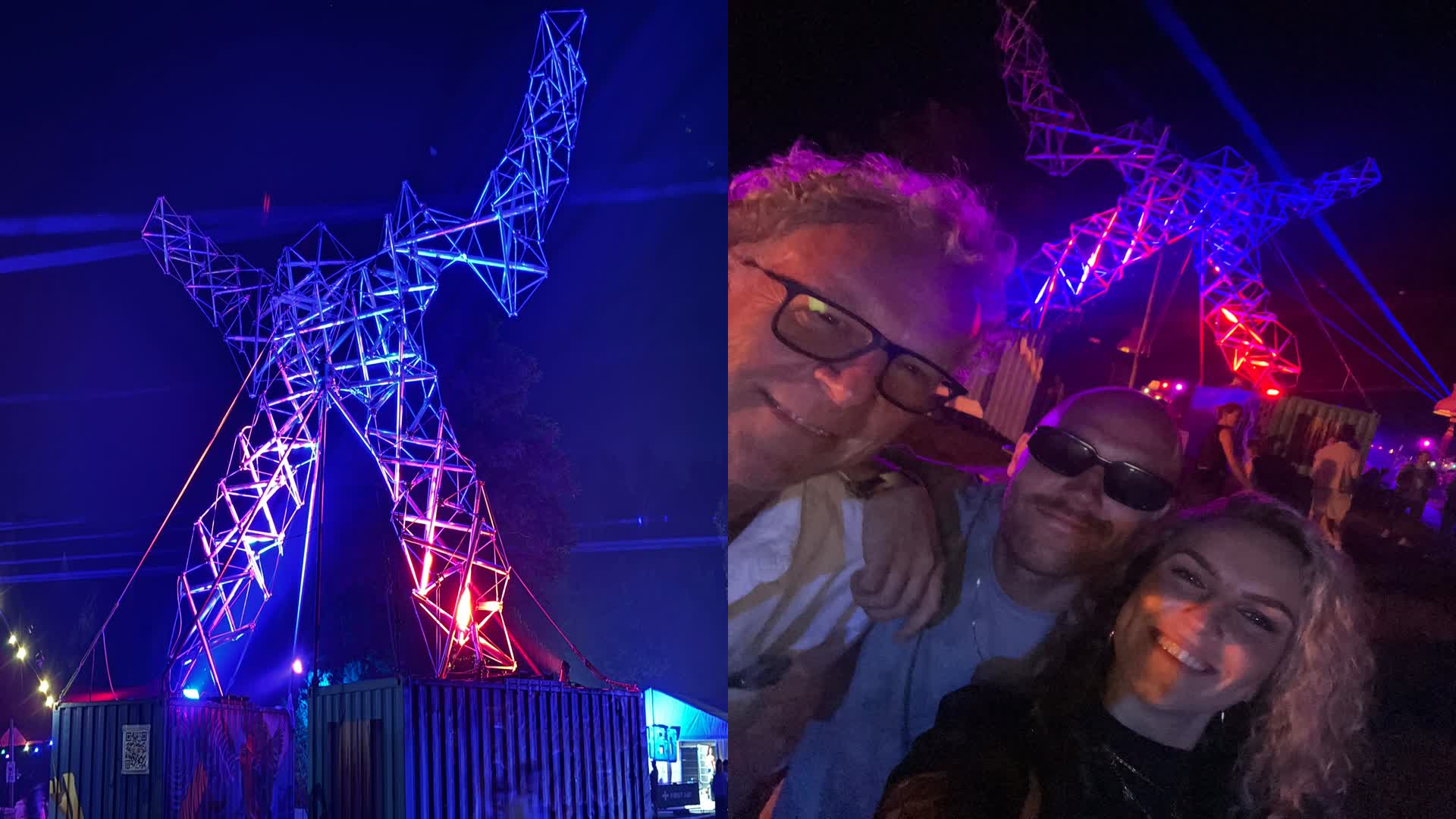
I went to the festival and I kept going back to De Twips every once in a while to once again gaze in wonder at how impressive this thing appeared to be. It was fun meeting people and being able to tell them that I was the artist responsible, and I was able to set aside the problems and start to forget all the extreme effort and the roller coaster of hope and disappointment that led up to this.
Lessons learned
This whole adventure was in one sense very unwise, and the evidence is in that it should have been done differently. The main points are these:
- Prototyping at scale. We attempted a prototype, it showed problems with the initial choices, but we skipped over the process of re-doing the prototype until the results were convincing and satisfying.
- Surrendering to time constraints. We didn’t do a second prototype because we assumed that we were smart enough to jump from the unsatisfying prototype to a new design that would just work. If we had done another prototype, we would have discovered the problem with the stainless steel threading. We should have dared to just call off the project, but we thought we were smart.
- A humanoid form is too ambitious as a first-of-its-kind. Since this was the first structure that we were building at this scale, we should have gone for a much more straightforward design without the fancy degree of freedom that we imagined. It should have also simply consisted of fewer parts, which would have made it less heavy and also less costly.
- Weight matters. The end result here weighed 800kg, which is monstrously heavy! Calculations must have ratcheted up. It has to have a certain strength, therefore the elements must be of a certain thickness, which made them heavier, which raised the strength requirements, etc. We should have been looking for every opportunity to reduce the weight, which would have allowed the design to settle on something much lighter.
- Beware of stainless steel. The most painful discovery of all was that stainless steel bolt and threading is a recipe for disaster since the thread seizes up. I still have nightmares.
We will not be defeated!
In a number of ways, the project was a failure, but, admittedly, it was an extremely impressive sight to behold during the Wildeburg festival where it stood up high and lit with the spotlights. When you have seen something like that, it makes you want to do it again and do it right.
My son said it best when he saw these photographs. “It makes you want to kneel down and pray to it!”. Haha, yes, let’s start a cult of tensegrity!
The one thing that this project accomplished is that the festival organizers could not help but see the enthusiasm and passion that drove us to get it up for the Wildeburg festival, so they were open to giving us a chance to try again. Stay tuned, because we will be doing it right next time!
Sneak preview
Here is a little peak into the preparations for the next project. This time we took the time to build a proper and super-strong prototype at scale.
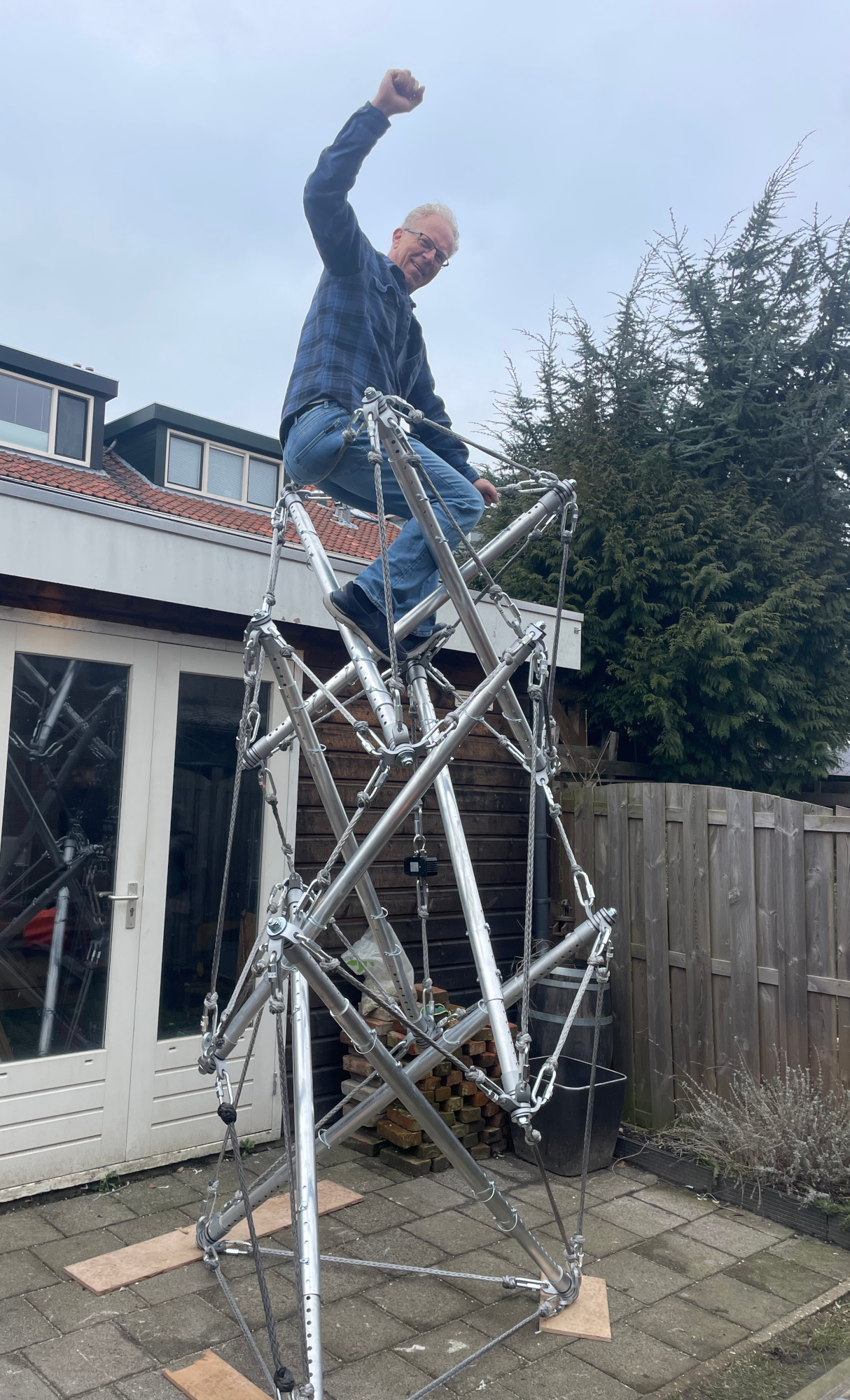
It was really gratifying to climb up on this extremely tight and strong prototype, and it was an extremely useful learning experience to have built it. This is the way.